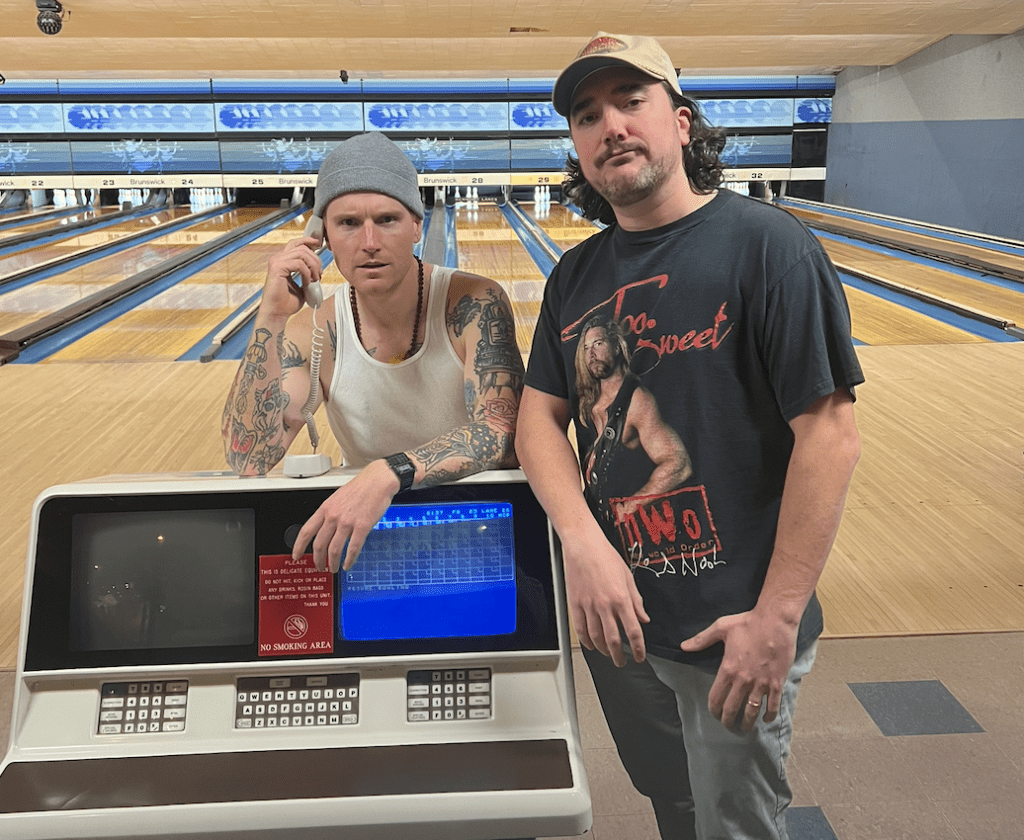
It’s a dark autumn night at Kenmore Lanes. We’re rolling at lane 28, talking about the madhouse that our country seems to be becoming.
“One of these days, I’m gonna get seriously injured by an animal. In my mind, it’s gonna be a lion or a tiger.” Jimbo is crouched, demonstrating his official US Postal Service dog-attack response moves.
“You’re supposed to use your bag- put it between you and the dog.” His invisible bag is now a Spartan shield. He’s grimacing as he thwarts the toothy blow of an imaginary beast.
I can tell from his eyes that he has considered killing several types of animals while delivering mail. He’s come to the lanes to blow off some steam, but he hasn’t had a drink yet.
“Didn’t some guy have a pet alligator?” Bernie asks.
The conversation has me convinced that an animal attack is imminent. I turn around and check my surroundings.
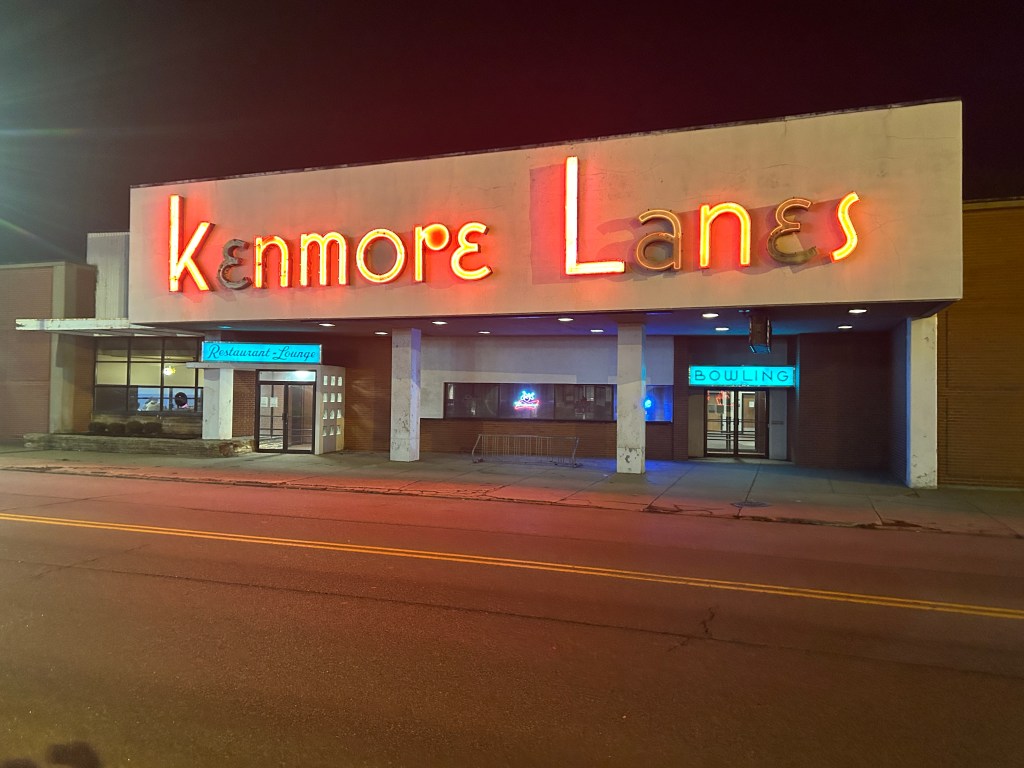
Kenmore Lanes is a gigantic, oddly horizontal place. The outside looks like an Edward Hopper painting – that sleek urban art deco aesthetic, with a hauntingly empty diner window. A massive, speedy, and graceful neon sign announces its presence. Kenmore Lanes.
The inside reveals a dark and enormous elliptical bar, above it, even larger, a strange architectural feature: a drop ceiling that looks like the underbelly of a Boeing B-17. As I stare, I wonder how many years of cigarette smoke gave it its color.
I can feel thousands of memories stored in this place. Birthday parties. Wars won and lost. First dates. Drinks after a funeral. Each one, now a speck of dust that clings to its obsolete mechanisms: Burnt-out spotlights with color gel inserts. A tube television. Black letters on a white pegboard above a milkshake blender.
There is something about this bar. My bones yearn to go back in time. To see the pizza parties. To hear the electronic melodies of Galaga and Pac-Man. No, to go even further back. Before my time. When the alley still served coffee in small diner mugs and doctors prescribed cigarettes for asthma. Kenmore Lanes has me stuck between two different eras. My grandfather’s and my own.
Like my grandfather’s time, the sleek aesthetic on the outside signals an era when men didn’t leave the house without wearing a hat. Cars looked like bullets, and men looked like Dick Tracy villains by the time they hit puberty. This was the era of the machine aesthetic. America buzzed with productivity, and it was fashionable to cover everything with chrome. Sleek horizontal lines everywhere, reminding us that America was moving forward.
Presently, it feels like America’s forward motion has stopped. In America, nobody seems to be moving at all. There are about 100 adult bowlers here, and almost all of them look like clinically overweight middle schoolers. Several of them wear t-shirts with awful sayings on them. Shirts my grandfather would have never worn.
One of them reads, “I EAT PUSSY LIKE KIDS EAT CAKE.” He’s sitting, scrolling on his cellphone, surrounded by an odd mess of Johnson’s baby powder. He is wearing a Bluetooth headset. He must take work calls between frames.
The sight of baby powder shakes me out of my daydream. I’m once again enthralled by Jimbo’s theatrics. He’s impersonating the other dangerous wildlife in the neighborhood he serves. The humans. He’s waddling pigeon-toed, wearing a face of disgust and exertion, miming the frumpy gait of a group of people he saw exit an all-you-can-eat Chinese Buffet.
“Every single one of them lit up a smoke.” He says as he lights an invisible cigarette.“Nobody walks anywhere!- They had it on the news! Wicked [the musical] is coming to town, so they showed a map of all the parking lots in the city… the suburbanites say there is nowhere to park…nobody walks anywhere.” Jimbo’s eyes squint over his imaginary cigarette at a bucket of beers. He waddles to it.
The boys agree. America looks like it’s on life support. Nobody walks, and I can’t blame them. Every time I’m under a bridge, I say a prayer. Everyone can see the rust and cracks that cover our infrastructure. We’re not building neighborhoods anymore. We’re building algorithms. Each of us is an unwilling participant. Addicted to our phones. As we build virtual reality, our concrete reality crumbles.
Under the B-17 bar, there is hope. His name is ‘Jay’. He has been walking here since 1983. The reason he is able to walk here is that the village of Kenmore was built during my grandfather’s era. When the human body was still considered in the design of human habitats. When people walked, rode bikes, and spoke to each other with their mouths. Cars were not important citizens. People were.
“I used to walk here when I was 7. We played Bad Dudes, right over there.” He points to the empty grey linoleum floor that used to support an arcade. I know his name because everyone who walks by says it. I can tell right away that this is Jay’s community.
“I loved Bad Dudes,” Lyles replies.
“Do you remember when Mortal Kombat 2 came out? I went to the mall, and there was a huge line just to play it. One guy was just killing everyone. When I finally got up there… he was Reptile- I never even heard of Reptile- I was always Sub Zero. Immediately, he turned invisible, did the acid spit… I lost so quickly. I was like, this game is fucking awesome. Changed everything.”
I ask myself, “Why is this conversation so charming?” It’s because Jay started it.
My friends and I are strangers. He interjected when D-Man mentioned The Simpsons. With his kind gesture (simply starting a conversation), we’re brought into the fold. Into the community of Kenmore Lanes. Jay is a legend here. Devoted to the place. League play. That’s 32 consecutive Friday nights a year you can find him here. With people he calls friends. Or as he puts it, “These assholes.”
Jay’s nostalgia gives me a feeling of loss. I hear people say that the social fabric of society is falling apart because people don’t go out and socialize anymore. “Third places” like bars and movie theatres are closing in record numbers. That means bowling alleys, too.
To think of Bad Dudes and Mortal Kombat… video games…as a place where people gathered to have a shared experience is so foreign to me now. The arcade cabinets are gone from Kenmoe Lanes, but Jay invites us to reminisce with him.
We have common ground. In our past and present. In the arenas of Mortal Kombat, the technicolor homes of Springfield, the mean streets of Bad Dudes, and tonight under the tobacco-stained ceiling our grandfathers built.
 Bowling Diarrhea
Leave a comment